
International Charitable Foundation "GLOBAL ALLIANCE FOR PEACE AND DEVELOPMENT"
Making Ukraine's Recovery Possible Through Humanitarian Demining
Humanitarian demining is the first step toward rebuilding communities, restoring access to land, reopening local economies, and creating safe conditions for Ukrainian families to return home.
Recovery begins with safe land
GAPD connects donors, communities, governments, and implementation partners to accelerate Ukraine’s recovery through humanitarian demining, safe land access, and coordinated action.
Why GAPD
GAPD does not replace operators, government agencies, or local communities. We connect them. Our role is to align priorities, coordinate implementation, reduce fragmentation, and ensure donor funding delivers measurable outcomes.
Recovery succeeds when every stakeholder works toward the same outcome. GAPD provides the coordination platform that makes this possible.
About GAPD
GAPD is Ukraine’s dedicated coordination and technical expertise platform for humanitarian demining and land release.
We help design and implement complex, multi-stakeholder projects — bridging government priorities, community needs, operational capacity, and international support into coherent, actionable programming.
GAPD is Ukraine’s dedicated coordination and technical expertise platform for humanitarian demining and land release.
We help design and implement complex, multi-stakeholder projects — bridging government priorities, community needs, operational capacity, and international support into coherent, actionable programming.
Our Mission
To facilitate the design, coordination, and implementation of complex, integrated projects in humanitarian demining and land release — enabling the safe and sustainable return of affected territories to productive use, in full compliance with national and international standards.
The Fund operates at the intersection of government priorities, community needs, operational capacity, and international financing requirements — with a clear focus on strengthening programmatic coherence and reducing the risk of gaps between planned and actual results.
GAPD is Ukraine’s dedicated coordination and technical expertise platform for humanitarian demining and land release.
We help design and implement complex, multi-stakeholder projects — bridging government priorities, community needs, operational capacity, and international support into coherent, actionable programming.
Who We Are
Global Alliance for Peace and Development (GAPD) is an independent Ukrainian charitable organization providing coordination and technical expertise across humanitarian demining, environmental recovery, psychosocial support, and community resilience.
GAPD works on complex, multi-stakeholder projects where government institutions, local communities, certified operators, and international partners must function as a coherent whole. In these projects, risk rarely emerges from execution alone — it accumulates at the intersection of government priorities, field realities, operator capacity, and donor requirements. This is precisely where GAPD operates: structuring projects, aligning implementation logic, and improving feasibility under real conditions.
Our Role
GAPD is not an implementing operator. It does not replace the functions of the state, donors, or accredited demining organizations, and does not exercise official oversight or formal acceptance of results.
GAPD works within Ukraine’s established humanitarian demining system, in coordination with authorized bodies, partners, and operators. Depending on the project, GAPD’s engagement may include:
- Structuring projects as interconnected, sequenced components
- Developing coherent implementation frameworks
- Facilitating coordination of roles, phases, and parameters across stakeholders
- Providing technical and coordination support to close the gap between planning and delivery
Field operations, technical control, certification, and formal acceptance of results remain the responsibility of the relevant authorized bodies.
How We Work
In complex projects, critical risks most often emerge at the transitions between phases:
Planning
Financing
Approval
Implementation
Handover
Insufficient alignment across these phases leads to delays, fragmentation, duplication of responsibilities, or partial project completion.
- Reducing fragmentation across project stages
- Building a coherent and consistent implementation structure
- Simplifying coordination among all stakeholders
- Strengthening alignment between project design and execution
- Closing the gap between the original plan and final outcomes
For partners, this means a more structured process, reduced need for parallel coordination, and lower risk of breakdown between phases.
Implementation Flexibility
GAPD adapts each project to its specific context — recognizing that no two demining or recovery projects operate under identical conditions. This means customizing project structures, combining modular components, applying flexible partnership formats, enabling phased implementation, and integrating both local community needs and national strategic priorities.
Where standard approaches fall short, GAPD identifies the adjustments needed to keep projects moving — whether that means restructuring sequencing, realigning stakeholder roles, or bridging gaps between donor requirements and field realities.
This adaptive approach increases the practical feasibility of complex projects and reduces the risk of misalignment between what is designed and what is ultimately delivered.
Why GAPD
In complex, multi-component projects, risks arise not only during execution, but at the intersections between planning, funding, and implementation.
GAPD works at these gaps — between those who set priorities, provide funding, coordinate, and implement — fostering more aligned interaction among all parties within the existing system.
This enables:
- Reduced operational gaps
- Stronger alignment of actions
- Simplified coordination for partners
- Increased project feasibility
GAPD does not create parallel governance mechanisms. Instead, it strengthens implementation coherence for complex projects within the existing system.
Our mission
To facilitate the design, coordination, and implementation of integrated projects in humanitarian demining and land release — enabling the safe and sustainable return of affected territories to productive use, in compliance with national and international standards.
The Fund operates at the intersection of government priorities, community needs, operational capacity, and international financing — strengthening programmatic coherence and closing the gap between planned and actual results.
Our vision
To support the rebuilding of a Ukraine where people return to safety, children learn in restored schools, and land reclaimed from war serves life once more — by facilitating the design, coordination, and implementation of integrated demining and recovery projects that meet the highest national and international standards.
Our values
Transparency. Open and accountable to partners, funders, and communities in everything we do.
Partnership. Genuine collaboration with governments, international organizations, and civil society toward shared goals.
People-Centeredness. Affected communities shape our work — their needs and voices drive every decision.
Innovation. New technologies and evidence-based methods to make recovery faster, safer, and more effective.
Sustainability. Results designed to last — beyond the project cycle and initial funding.
Recovery Programs
Humanitarian Demining
Veteran Reintegration
Environmental Restoration
Safe Communities Initiative
Workforce Development
Innovation and Knowledge
How We Work
Effective demining and recovery projects fail not because of a lack of funding or intent — but because the logic connecting planning to delivery breaks down somewhere in between. Roles blur, sequencing drifts, and the gap between what was designed and what gets built widens with every uncoordinated handover.
GAPD’s working methodology is built around one core principle: that structured coordination at every stage of a project’s lifecycle is not an overhead — it is the condition for results.
We engage from the earliest stage of project design, not as a late-stage troubleshooter. This means the projects we support are structured for delivery from the outset — with clear roles, realistic sequencing, and implementation logic that accounts for the actual capacity of every stakeholder involved.
Throughout the process, our focus remains on the transitions — the moments between stages where risk concentrates and where early intervention has the greatest impact on outcomes.

1. Project Preparation
Analyzing context, defining priorities, and structuring projects to reflect government policies, community needs, and real implementation conditions — before commitments are made and resources are deployed.
2. Alignment of Approaches and Parameters
Facilitating coordination of roles, sequencing, and implementation parameters across all stakeholders — ensuring that each party understands its responsibilities and that the project logic holds across institutional boundaries.
3. Implementation Support
Providing coordination and technical expertise throughout delivery — with a focus on maintaining inter-stage coherence, identifying emerging risks early, and supporting course correction before gaps become delays.
4. Completion and Handover
Supporting the structured closure of projects and the transfer of results in full accordance with established procedures and the mandates of the relevant authorized bodies.
What Partners and Donors Gain
Structured projects
Less distance between project design and actual execution.
Coordinated stakeholder engagement
Reduced misalignment, fewer delays, no duplication of functions.
Reduced coordination burden
Less need for parallel manual process management on the partner side.
Improved decision feasibility
Stronger alignment between the plan and real delivery conditions.
Analytical support
A stronger evidence base for decision-making and partner engagement.
Institutional compatibility
Full alignment with government procedures and international financing requirements.
Our Projects
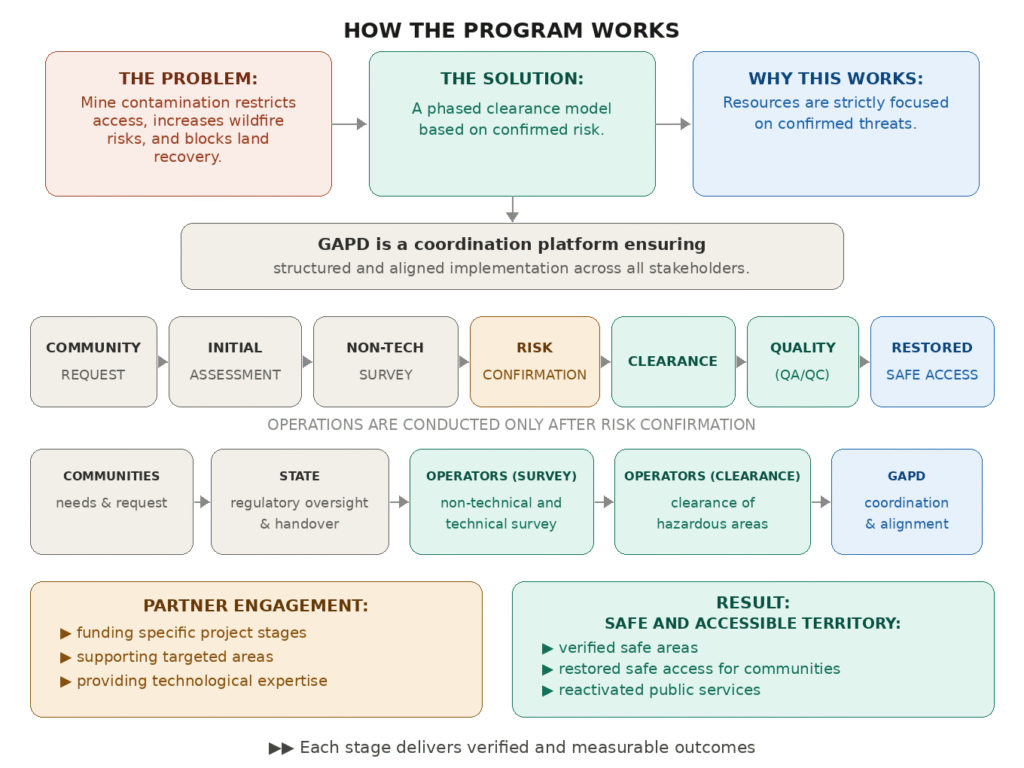
Ukraine’s most mine-contaminated territories cannot wait for perfect conditions. GAPD structures projects so that funding reaches verified threats, implementation holds across every stage, and results are formally transferred to the state — not left in a report.
Project stages
Survey
Risk confirmation
Clearance
Access restored
Land in use
What makes this project different
Pilot zone: Narodychi community
Priority sites identified, risk mapping underway, clearance preparation in progress.
Funding tied to confirmed stages only
Resources go to verified threats — not estimates, not projections.
Results cannot be lost to re-mining
Long-term return on investment protected by the nature of the operating area.
Certified operators only
All works carried out to national and international mine action standards.
IMSMA / GIS / DREAM tracking
Every stage documented, traceable, and reported through recognized systems.
Independent QA/QC + state handover
Results verified independently and formally transferred to authorized state bodies.
Impact and results
Restored access
Roads, firebreaks, and forest corridors returned to safe use.
Emergency vehicles reach areas closed since 2022.
Reduced risk
Wildfire risk and secondary hazards reduced for local population.
Wildfire containment becomes operationally possible.
Emergency services
Response teams regain operational access to previously blocked zones.
First responders re-enter areas blocked since 2022.
Economic recovery
Natural resources and agricultural land returned to productive use.
Farmers and foresters return to productive land.
Transparency and Quality Control
Trust is our most valuable asset. That is why we operate openly and with accountability.
We believe that every charitable contribution is an act of trust that must be honored. Our activities are completely transparent: all financial transactions are monitored, every project is publicly documented, and the quality of implementation is validated by both detailed reports and on-site feedback.

Financial Transparency
- All projects are integrated in the DREAM system
- Public reports and regular audits
- International monitoring of our reporting, with independent evaluations of project outcomes
Project Oversight
- We employ technical supervision at every construction site
- We evaluate the results of project implementations
- We collect feedback from those who have received assistance
Anti-Corruption Policy
- Zero tolerance for misconduct
- An anonymous complaints box is in operation
- All procurements and contractor selections are conducted through transparent procedures
How you can help
Financial Support
Become a Partner or Donor
Volunteer
Provide financial support
Online donation via the website
Bank transfer (with the option to specify the purpose)
Regular support
Opportunity to receive tax benefits
We guarantee that the funds will be used as intended!


For organizations: foundations, businesses, international institutions
Options:
- Cooperation in specific areas
- Joint projects
- Conclusion of grant agreements
We propose: to jointly identify needs, submit project proposals, and conclude official agreements…
Become a Volunteer
Field operations: tree planting, kindergarten renovations, etc.
Online assistance: design, translation, IT support
Complete the “Become a Volunteer” form
If you are a builder, a healthcare professional, a lawyer, or an IT specialist – we invite you to join our volunteer database.



Humanitarian partners



International Charitable Foundation "GLOBAL ALLIANCE FOR PEACE AND DEVELOPMENT"
Code: 45856278, Registration Number: 1000741020000109465
51B Bohdan Khmelnytskyi St., Siute 10, Kyiv 01054, Ukraine


